
LeadHERship
Purpose Has to Reach the Work
September 9, 2026
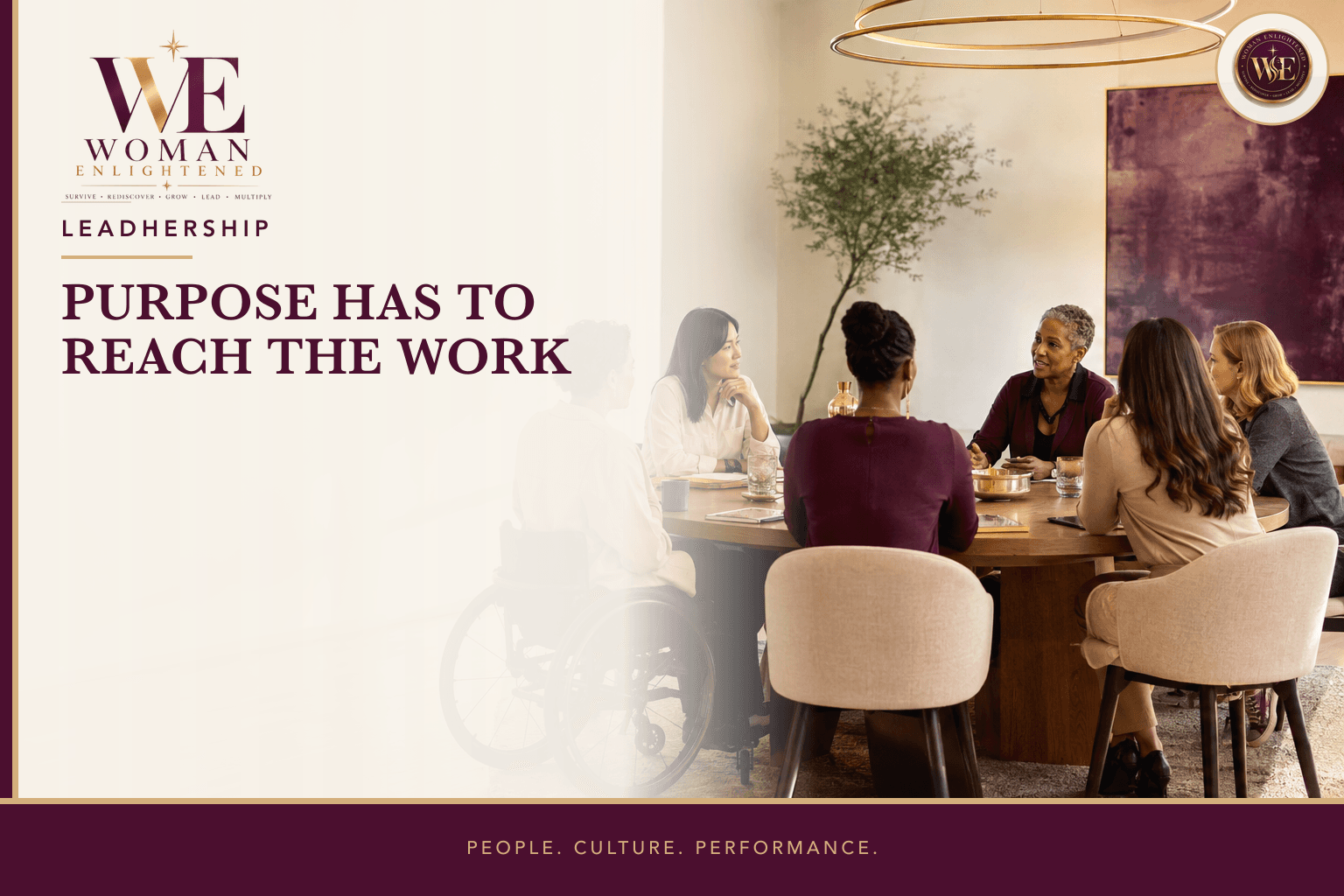
I would put one question in the center of the leadership table right now: When everything around the work keeps changing, what are we asking purpose to do?
If the answer is inspire people, I think we are asking too little of it.
Purpose has to help people decide.
It has to help an executive choose what not to trade away for speed. It has to help a leader explain why one priority moved ahead of another. It has to help an employee understand how her judgment still matters when the role, the tool, or the expectation has changed again.
That is a different job than appearing in the opening slide of a town hall.
Gallup's February 2026 workplace findings make the gap difficult to dismiss. Only 31 percent of United States employees strongly agreed that they felt connected to their organization's mission or purpose. Fewer than half strongly agreed that they knew what was expected of them at work. Only 27 percent strongly agreed that their opinions counted.
Those are three separate measures, but together they put a familiar tension on the table.
An organization can have a clear purpose statement while its people remain unclear about the work, unheard in the change, and disconnected from what the statement is supposed to mean.
PwC's 2026 workforce and CEO findings describe the pressure from another angle. Employees are experiencing sustained change, not one transformation with a clean ending. Thirty-five percent reported feeling overwhelmed at least weekly. Fewer than two-thirds said they understood their organization's goals, and only 56 percent said they believed leadership could achieve them.
No single survey can explain every workplace. These findings do not prove that purpose alone will repair trust or performance. They do tell us that speed without clarity is already landing on people who are carrying uncertainty, fatigue, and uneven confidence in leadership.
That is why I would not treat purpose as a culture message right now. I would treat it as operating infrastructure.
What must remain true while the strategy changes?
Who is this decision meant to serve?
What tradeoff are we willing to make, and which one would violate what we say we believe?
Those questions turn purpose into something people can use.
At the executive level, purpose should discipline the portfolio. If every initiative is called essential, purpose is not guiding the work. It is decorating the workload.
At the leader level, purpose should make translation possible. A manager should be able to explain what changed, why it changed, what did not change, what good judgment looks like now, and where the team still has room to shape the answer.
At the employee level, purpose should create a credible line of sight. People do not need to see themselves in every sentence of the strategy. They do need to understand how the work in front of them connects to a real outcome and why their experience is worth hearing before the process hardens around a weak assumption.
Partners and vendors need the same clarity. We cannot ask an external partner to protect a culture we have not translated into the decisions, measures, and boundaries of the work.
The industry is responding with employee listening, manager development, workforce redesign, reskilling, and more transparent change communication. Those moves matter. Gallup recommends using engagement data to locate the specific breakdowns in expectations, development, purpose, and voice rather than offering broad manager training and hoping it reaches the right problem. PwC is calling for strategy, skills, trust, and workforce outcomes to be aligned at the leadership level.
I agree with that direction.
I also believe it remains incomplete when purpose is discussed separately from the decision people are being asked to absorb.
A listening session after the operating model is finished may gather reaction. It does not create shared understanding early enough to improve the choice.
A manager toolkit may help with delivery. It cannot answer a question the executive team never resolved.
A purpose campaign may create energy. It cannot overcome a workload that teaches people the opposite of the message.
If we want purpose to survive change, we have to move it upstream.
Bring it into the meeting where priorities are removed, not only the meeting where priorities are announced.
Bring employee and customer evidence into the room before certainty becomes expensive.
Ask managers what they will have to explain on Monday morning. Ask partners where the standard is unclear. Ask employees which part of the proposed change depends on knowledge the project plan has not captured.
This is where leaders will find the answers: in repeated exceptions, customer friction, unfinished work, quality reviews, employee questions, partner feedback, and the difference between the process on paper and the work people actually do.
It is also where we found the real AI adoption questions in If Leaders Are Learning AI, Why Are Employees Still Guessing?. The technology may change. The leadership obligation does not. People need enough context to use judgment well.
For the next consequential change, I would ask the leadership team to complete one sentence before approving the communication plan:
Because this is our purpose, this decision requires us to protect ______, change ______, and listen for ______.
If the team cannot finish that sentence with specificity, the organization is not ready to ask everyone else for commitment.
Purpose does not remove the difficulty of change. It should make the difficulty more honest, the tradeoffs more disciplined, and the next decision clearer.
That is what people need from it now.
If you are navigating more than one kind of change at once, explore the Five Discoveries as a way to name the season before choosing the next move.
When you are ready
Let this entry keep you company.
You do not need to do everything next. Choose the one place that feels useful in this season.
Your private next step
What stayed with you?
Open a fresh page in your private Digital Journal with this entry held as the starting point. Your writing remains visible only to you.
Reflect in my JournalSecure member sign-in required.
Keep this close
Save this entry to your private resource library so you can return without searching for it again.
Continue your path
Return to the one action currently waiting for you on your Purpose Path.
Return to my Purpose PathA related Discovery theme
Leading
Explore this Discovery as a season of experience, not a label or a measure of your worth.